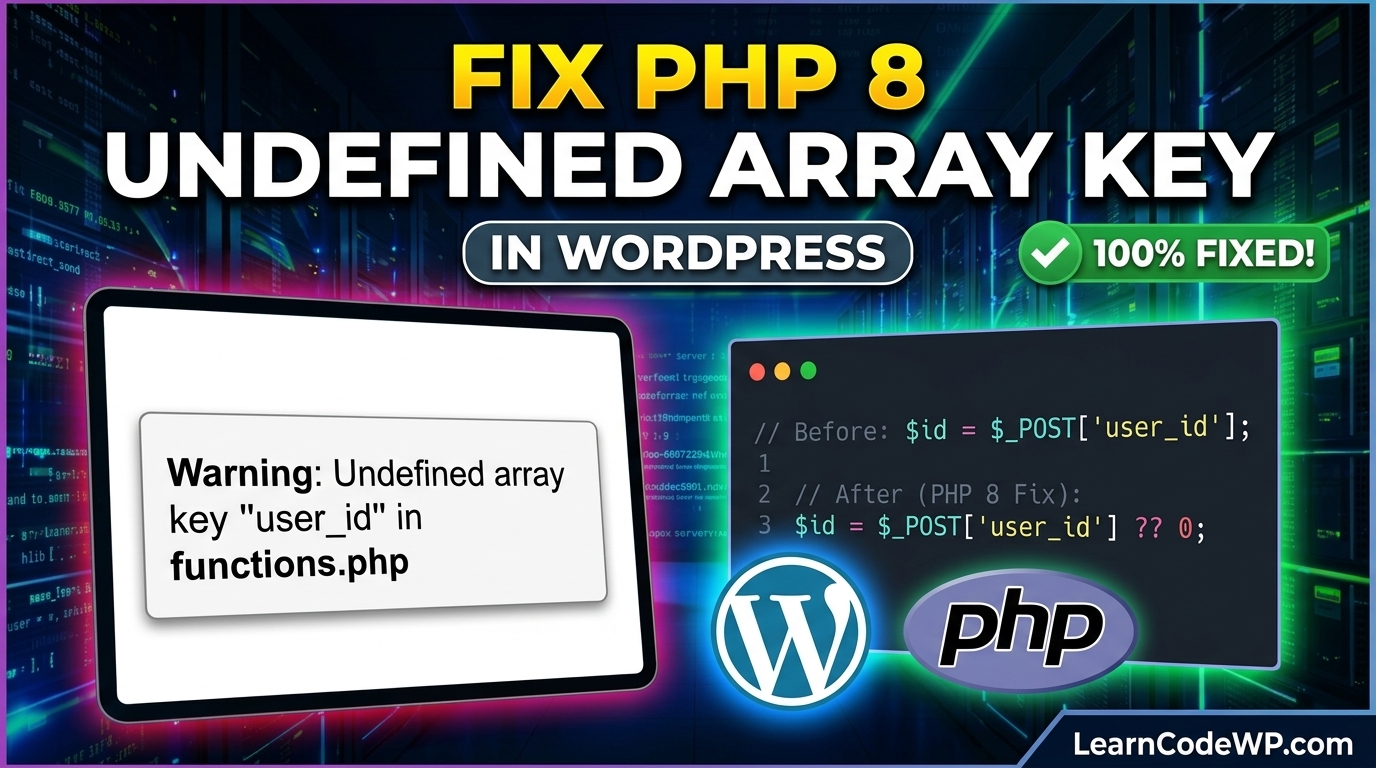

If you recently upgraded your server and need to fix php 8 undefined array key warnings in your custom WordPress code, you are not alone. PHP 8.0 brought massive performance improvements, but it also introduced stricter type safety and error reporting. In PHP 7.x, accessing a non-existent array key triggered a silent E_NOTICE. Your site kept running, and unless you looked at debug logs, you never knew it was broken. PHP 8.x changes the game. It elevates these notices to full E_WARNING alerts. If your site has WP_DEBUG enabled or prints errors to the screen, these warnings can break AJAX responses, corrupt JSON payloads, or clutter your server logs until they run out of disk space. Don’t just copy-paste some quick fix blindly—check your server config first to see how your logs are handled.
Why You Must Fix PHP 8 Undefined Array Key Warnings
Historically, PHP was highly forgiving. If you tried to pull a key from an array that was not set, PHP assumed you wanted null and carried on. A mistake I see developers make all the time is writing theme files that directly access global variables or $_POST arrays without checking if the keys exist. Under PHP 7.4, this works without throwing a visible fit. Under PHP 8+, if a key is missing, PHP immediately throws a warning. Let’s look at what actually happens under the hood: PHP is forcing developers to write cleaner, more deterministic code. If your theme relies on unsafe array access, you will inevitably run into issues where your layout breaks or your database is populated with empty values.
Here is the catch: hiding the warning by turning off debug mode is a temporary band-aid, not a solution. If that array key is missing, your logic might be processing null values where it expects strings or arrays, leading to fatal type errors down the line. To fix php 8 undefined array key warnings, we must refactor our custom functions to handle missing keys gracefully.
Using Null Coalescing to Fix PHP 8 Undefined Array Key Warnings
The most elegant solution introduced in PHP 7.0 but absolutely essential in PHP 8 is the null coalescing operator (??). It allows you to define a default fallback value if the array key does not exist or is null. This is the cleanest way to fix php 8 undefined array key issues in WordPress meta boxes, form submissions, and query parameters.
functions.phpadd_action('save_post', 'lwp_save_custom_meta_box_data');

function lwp_save_custom_meta_box_data($post_id) {
    // 1. Verify nonce safely
    if (!isset($_POST['lwp_meta_box_nonce']) || !wp_verify_nonce($_POST['lwp_meta_box_nonce'], 'lwp_save_meta_box')) {
        return;
    }

    // 2. Check autosave
    if (defined('DOING_AUTOSAVE') && DOING_AUTOSAVE) {
        return;
    }

    // 3. Safe array access using null coalescing
    $text_field = $_POST['lwp_custom_text_field'] ?? '';
    $checkbox_field = isset($_POST['lwp_custom_checkbox']) ? '1' : '0';

    // 4. Update post meta
    update_post_meta($post_id, '_lwp_custom_text_field', sanitize_text_field($text_field));
    update_post_meta($post_id, '_lwp_custom_checkbox', $checkbox_field);
}
Let’s do a line-by-line breakdown of what this code does. First, we check if the nonce exists using isset() before verifying it. This completely avoids a warning if the post is saved via an automated script or API where the nonce field is absent. Next, we use the null coalescing operator. If $_POST[‘lwp_custom_text_field’] is missing, PHP assigns an empty string to $text_field instead of throwing a warning. Finally, for the checkbox, we use a standard ternary operator with isset() because checkboxes are completely omitted from $_POST when unchecked.
Comparing Safe PHP 8 Array Access Techniques
When refactoring your codebase to fix php 8 undefined array key errors, you have several tools at your disposal. Each has its own best-use case depending on whether you need fallback values or strict boolean checks.
| Method | PHP 7/8 Syntax | Best Use Case | Result if Key Missing |
|---|---|---|---|
| Null Coalescing | $val = $arr['key'] ?? 'default'; | Assigning fallback values | Returns ‘default’ (No Warning) |
| Isset Check | isset($arr['key']) | Conditional logic / Checkboxes | Returns false (No Warning) |
| Array Key Exists | array_key_exists('key', $arr) | Checking for keys with null values | Returns false (No Warning) |
| Legacy Direct Access | $val = $arr['key']; | Avoid entirely in PHP 8 | Throws E_WARNING |
Troubleshooting Deeply Nested Arrays & Caching Gotchas
Here is another catch: sometimes your custom code relies on nested arrays, such as retrieving options from a complex theme options framework. If you write $val = $options[‘layout’][‘sidebar’] ?? ‘default’, PHP 8 will safely resolve the entire chain even if ‘layout’ or ‘sidebar’ is missing. However, if $options[‘layout’] is a string instead of an array, PHP will throw a fatal error. Always ensure the base variable is actually an array before chaining deep keys. You can use is_array() to verify this before accessing nested structures.
Another common issue is caching. If you are using object caching or OPCache, your server might still serve the compiled, broken PHP 7 code even after you upload your fixes. Always flush OPCache or restart your PHP-FPM service after deploying these structural refactors to ensure your changes take effect immediately.
Frequently Asked Questions
Will an undefined array key warning crash my live WordPress site? No, it won’t trigger a fatal crash like a compilation error would, but it can break AJAX functionality, corrupt REST API JSON payloads, and inflate your error logs, which can eventually exhaust your server’s disk space.
Can I just downgrade my server to PHP 7.4 to fix this? Do not downgrade to PHP 7.4. PHP 7.4 reached its official end-of-life in late 2022. Running unsupported PHP versions exposes your server to critical security vulnerabilities and misses out on massive performance gains.
What is the difference between isset() and array_key_exists() in PHP 8? The isset() function returns false if the key exists but its value is explicitly set to null. Conversely, array_key_exists() returns true as long as the key exists, regardless of its value. Use isset() for speed unless you explicitly need to detect keys containing null.